

| Type | Examples |
|---|---|
RECAPTCHA | Google reCAPTCHA v2, v3 |
HCAPTCHA | hCaptcha checkbox, image challenges |
CLOUDFLARE | Cloudflare Turnstile, Challenge pages |
FUNCAPTCHA | FunCaptcha / ArkoseLabs |
MTCAPTCHA | MTCaptcha |
TEXT_CAPTCHA | Distorted text/number images with an input field |
OTHER | Unrecognized CAPTCHA types |
Use error_code_mapping
When a CAPTCHA blocks your automation, this gives you a consistent error code instead of parsing free-text failure messages.
output.error = "cant_solve_captcha". You can branch your logic on this code.
For more on error code mapping and handling failures programmatically, see Error Handling.
Take Control from the browser stream
In the Cloud UI, head to Runs > Click on your run > Click on the “Take Control” button over the browser stream. This lets you manually solve CAPTCHAs.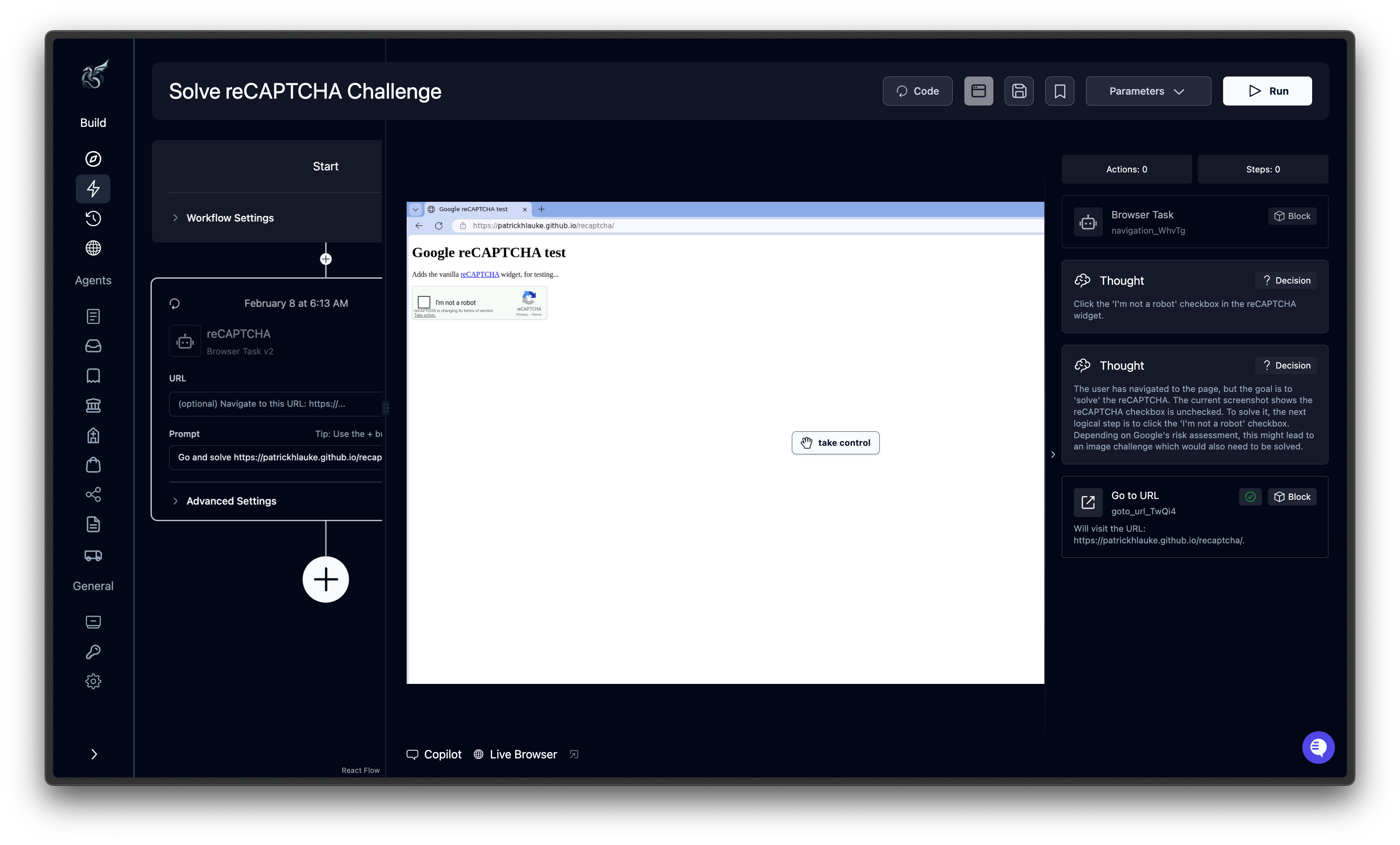
Built-in bot detection avoidance
Skyvern automatically configures the browser to reduce bot detection triggers. These protections apply to every run. No configuration needed.AutomationControlleddisabled: Removes the Blink feature flag that marks the browser as automatednavigator.webdriverhidden: Theenable-automationflag is suppressed so JavaScript detection scripts don’t see a webdriver- Viewport and user agent: Set to match real consumer browsers
- Locale and timezone: Automatically matched to the proxy location (see Proxy & Geolocation)
Reducing detection risk
Beyond fingerprinting, how you structure your automation affects detection:- Use residential proxies for sensitive sites: Datacenter IPs are the most common bot signal. Residential proxies route through real ISP addresses. Set
proxy_location="RESIDENTIAL"or useRESIDENTIAL_ISPfor static IPs. - Reuse browser sessions for multi-step flows: Creating a fresh browser for every step looks suspicious. A persistent session maintains cookies, cache, and history. See Browser Sessions.
- Use browser profiles for repeat visits: Profiles save browser state from a previous session. The site sees a known browser with familiar cookies instead of a blank slate. See Browser Profiles.
- Add wait blocks between rapid actions: Instant actions can trigger behavioral detection. A short pause between steps looks more human.
If you get blocked
- Increase
max_steps: Some bot challenges (like Cloudflare) loop through multiple verification pages. More steps give the solver more attempts. - Switch to a residential proxy:
RESIDENTIAL_ISPprovides a static IP that services are more likely to trust. - Use a browser profile that previously passed: If a profile has already cleared a Cloudflare challenge on a domain, it’s more likely to pass again.
- Load Chrome extensions: Extensions can add additional stealth capabilities. Set
EXTENSIONSandEXTENSIONS_BASE_PATHin your environment.
Self-hosted deployments
Automatic CAPTCHA solving is not available for self-hosted deployments. Instead, when a CAPTCHA is detected, the agent pauses for 30 seconds to allow manual intervention. Solve it in the browser window yourself, then the agent continues automatically.Next steps
Proxy & Geolocation
Route traffic through residential proxies in 19 countries
Handle 2FA
Configure TOTP, email, and SMS verification codes
Browser Sessions
Persist browser state across multiple runs
Error Handling
Map CAPTCHA and bot failures to custom error codes